Differences Between Onshore vs Nearshore vs Offshore Software Development and How to Choose Correctly
January 19, 2025 — 13 min read

Software development outsourcing is a big topic. In fact, it’s huge. Last year, more than 28 million people across the world were software developers. This figure is expected to swell to 45 million by the end of the decade.
But the most advanced global regions are also the ones short on developer talent. That spells trouble for US and EU companies. Developers in the West are getting more expensive and less numerous, as boomer workhorses go into retirement and millennials hold onto their title as the least employed and least engaged generation. In general, if you’re hiring in the West, you have no choice but to look at foreign shores. (Of course, the situation is even worse in the unsexy public sector.)
This short article is packed with useful info. You’ll learn what onshore, nearshore, and offshore outsourcing really means. You’ll get acquainted with their pros and cons. And you’ll learn how to prepare and avoid outsourcing pitfalls.
All of that for a single goal: to hire a software development firm that is the best solution for you.
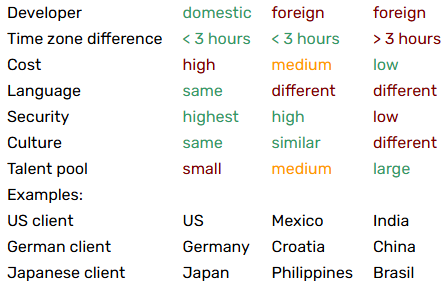
The Onshore column is the greenest because it is the comfort zone. But don’t let it fool you. For most companies, the Cost row is the sweetest incentive to outsource. And there, proverbially, the grass is greener on the other side.
Software outsourcing is when you hire outside people to do your software development for you. They aren’t your employees, they are an independent firm. Outsourcing is traditionally divided according to its closeness to home:
Software outsourcing is the global norm. But until recently, it used to be an exception. It’s easy to forget that international business cooperation was a complicated and expensive procedure only a couple of decades ago. Medium and small businesses could only realistically choose among developers from their own country (i.e. onshore). And since the savings weren’t so great, many were ready to spend a little more to have their own IT teams instead of trusting strangers.
Since communications and technologies have become truly globalized, nearshore and offshore outsourcing is much less of a hassle now. You don’t have to be a multinational behemoth to strike deals with teams in India or China. Any startup can do it.
So, obviously, the global IT outsourcing market is skyrocketing. Its 2024 revenue is estimated at $512 billion. Just three years ago it was believed this figure would be reached only in 2025.
Outsourcing is less and less about lowering costs. There’s simply nobody left to hire in the richer countries any more. The recent pandemic-fueled remote work and the Great Resignation have aggravated the war for talent. The world hungers for IT hands, from code cadets to crypto zen masters.
The developing world is catching on and pouring more and more resources into IT education. No matter what software you need, you can bet there’s someone in Croatia or Brazil who has just the right thing for you, because they have already done a similar job for another client from your country.
But why do companies outsource software development? What are the reasons they give? Almost 60% of companies are outsourcing their work to increase productivity, while 64% of outsourced work is related to software development. These are some of their reasons for outsourcing, listed in order of importance:
So the real issue is what outsourcing model to choose: onshore vs nearshore vs offshore software development.
Each model has its own strengths and weaknesses.

Developing your project on your home turf has some distinct advantages.
Pros of onshore outsourcing:
Cons of onshore outsourcing:

The most obvious difference between onshore and offshore is the difference in cost. That’s the great plus of offshore outsourcing. However, when you look at offshore outsourcing pros and cons, you’ll see many possible disadvantages; you have to be extra careful with offshore jobs. In a Deloitte survey, 20% of the respondents were planning to “backshore” in the near future.
Offshore outsourcing is a great solution for simpler projects, like an established process that needs to be scaled, or product testing.
Pros of offshore outsourcing:
Cons of offshore outsourcing:

Nearshore outsourcing tries to combine the best of onshoring and offshoring.
The advantage of nearshore vs offshore software development is the same time zone and usually a similar working culture. The advantage of nearshore vs onshore is lower cost, though not as low as offshore, and a large talent pool.
For the US and Canada, nearshore is Latin America. For Western Europe, it’s Central and Eastern Europe.
You could use a combined approach: find a team where the lead developer is from your country and the rest is nearshore or offshore. Or you could have a local project manager. Either way, you will partly avoid the communication problem.
This is about your needs. The question of when to outsource software development is the question of when you’ve run out of money or resources to realize your plans.
You should outsource if:
And this doesn’t just apply to cash-strapped startups or mid-sized businesses. With software development outsourcing expected to rise year by year, we shouldn’t ask which companies use outsourcing, but which ones don’t.
Skype chose Estonia, Google relies on Southeast Asia, and Apple went to China. Sometimes it goes the other way round. In its early days, Alibaba outsourced to the US: as a Chinese company, it already had cheap labor, but it lacked top skills.
The focus on outsourcing means a focus on your integration with the remote team. Before you go looking for software developers, you need to answer these questions about your software:
What really matters is what kind of service you get. Let’s see how to hire a software development company that promises to be reliable.

I already wrote about some general considerations when hiring someone. These six points are particularly important:
As for where to look, it depends on what kind of software you need. And finding candidates has never been easier. You can put a free ad on hiring platforms like Upwork, Freelancer, PeoplePerHour, Guru or Dice. You can browse professional communities like Stack Overflow or LinkedIn. Even a simple search on Google will give you ideas. I’d suggest trying all that just to get a feeling of what’s out there.
Or you can start by choosing a region or country of preference. I find this one interesting:
Central and Eastern Europe. The standard of Central and Eastern European countries may be catching up with their wealthy Western neighbors, but they still offer great value for money, with high professionalism, no cultural barriers, and English proficiency. Croatia is the only country in Central and Southeast Europe that is in the top 5 countries where people speak English with very high proficiency.
To recap, here are the main points:
If you’ve made it this far, you know that the basic question of onshore vs nearshore vs offshore development isn’t about particular countries at all. It’s about your own priorities.
But if you aren’t crystal clear about what you want, or if you need to discuss it with someone who knows the market, contact us at Q Agency for help and guidance.
With more than a decade of successful software projects behind us, we listen carefully and explain clearly. And we never forget your goals: our digital strategy goes hand in hand with your business strategy.
We respect your product and your money. And we deliver.
The Times Travel web platform on which our experts have worked is a prime example of how software development outsourcing results in great user satisfaction and business success. Click here to see the Times Travel case study.

A digital marketing expert with over 20 years of experience as a marketer, designer, content creator, strategist and lecturer.
Partner with us