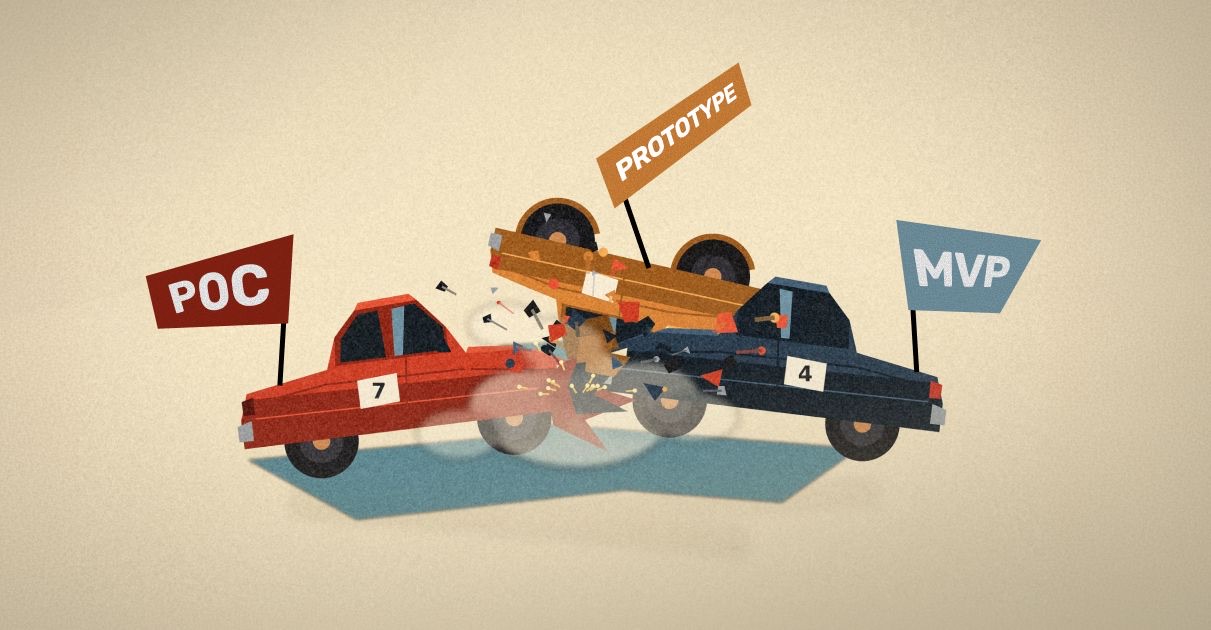
Wondering about the strategic and operational differences between starting your IT project with a POC, Prototype, or MVP? Want to understand proof of concept vs prototype, POC vs prototype vs MVP? Let us tell you a story.
The story begins with a guy named David, the CEO at a financial company. David recognises AI’s potential, but at the same time faces the loudest quiet fear: Will the industry move faster than him? When his VP of Product walks in with an idea for a custom financial calculator, David’s experience suggests that it’s a great idea. However, he is very aware of Eric Ries’s famous warning: “There is surely nothing quite so useless as doing with great efficiency what should not be done at all.”,so he knows that they need an immediate idea test.
The VP of product is throwing around terms like POC and Prototype, and David just heard about a competitor’s great success with an MVP.
He understands the terminology, and he knows that modern development tools enable teams to build these assets faster than ever before. Yet, he lacks 100% certainty on the strategic differences, confronting a dilemma familiar to every technology decision-maker:
What do I actually need, how much will it cost, and what is the best fit for my situation?
To make the right decision, David must first look at the most common reasons why tech projects fail.
These reasons include not assessing and underestimating Value, Feasibility and Usability risks.
- 42% of tech initiatives die because they misunderstood market demand. This means they didn’t assess the Value risk and they built a product for which there was no interest (Source: CB Insights)
- 45% of software projects go out of the budgets. We can assume that they underestimated the Feasibility Risk, in other words – engineering complexity. (Source: McKinsey)
- 25% of projects fail because of the bad UX and adoption friction. These were the situations where users didn’t understand the solution, even though the tech worked – Usability Risk. (Source: The Standish Group)
So, to avoid these roads, David gets to choose some of the three doors in front of him:
Door 1: Proof of Concept (PoC)
Will it work?
Preparing a Proof of Concept means developing and testing isolated core functionality and prioritizing technical reality (feasibility questions) over user experience and overall impression.
- the Scope: Restricted, focused entirely on a hypothesis that needs to be validated.
- the Goal: Validating the core concept and uncovering
- potential algorithm, architecture, integration blockers.
- the PoC on the Calculator Example: A raw, interface-free script to test if the AI math engine can successfully parse complex tax data from a client’s legacy system and process the calculator’s core algorithm in under two seconds.
- Eliminates critical Feasibility Risk before wasting months of development on flawed technical assumptions.
Door 2: Prototype
How will it function, look and feel?
A Prototype includes broader scope to simulate the main workflows and visual representation of the product, before writing final production code.
- the Scope: Built around the “happy path” of the user journey – the core features that bring the highest value to both users and company and will be used most frequently.
- the Goal: A clickable part of the solution loaded with dummy data, perfect for securing stakeholder buy-in and capturing early feedback, alignment or building confidence.
- the Calculator Prototype Example: A quick, working web page using a basic frontend framework. Users can type in their numbers, adjust the slider bars, and watch the calculator compute results on the screen in real-time. It doesn’t save their user profiles or link to a payment gateway, but it lets clients experience a Happy path.
- Eliminates crucial Usability Risk (and elements of feasibility risk) by testing solution feel and system capabilities through rapid, cheap iterations.
Door 3: Minimum Viable Product (MVP)
Will they use it and pay for it?
A fully functional, bare-bones version of the product built using real code, live database architecture, and deployed to a select group of users.
- the Scope: Sacrifices the non-essential “nice-to-haves” to deliver the leanest functional application.
- the Goal: While a prototype checks how a problem should be solved visually, the MVP proves whether the problem is real and if the market values the solution.
- the Calculator MVP Example: A simplified, coded web application. It connects to live market data streams and allows selected beta clients to input their real corporate financials. David can now track if these companies use the calculator regularly and whether they would be willing to pay a monthly subscription for it.
- Even though it demands the highest upfront investment, MVP brings the greatest clarity by simultaneously defusing Value, Usability, and Feasibility risks.
The shortest Decision Matrix
High technical or legal uncertainty? Asking yourself if it will work? → Build a POC. (Timeline: 2–3 weeks)
Tech is straightforward, but the user workflow is complex? Asking yourself how it will function, look, and feel? → Build a Prototype. (Timeline: 2–4 weeks)
UX is validated, and you need to prove real market demand? Asking yourself will they use it and pay for it? → Build the MVP. (Timeline: 2–3 months)
Back to David.
David sits in his office, looking at a spreadsheet of his budget. He knows that going straight to an MVP could cost him thousands of euros and months of development if his assumptions are wrong. At the same time, being stuck with minor experiments might mean losing the momentum completely. The clock is ticking, the board is waiting.
The ultimate truth for David – and for your own project – is that the answer to “which one reduces risk fastest?” depends on which specific risk is your biggest threat.
Is your biggest risk from the feasibility, usability or the value domain?
David reaches for the handle of the door, ready to stake his reputation on the answer.
What do you think? Which door is the best choice for David? Which door are you opening at Monday’s executive meeting?
Need help before opening the door? Reach out to our team!
Give Kudos by sharing the post!
ABOUT AUTHOR

Vesna Palada
Presales Engineer