
What does it really mean to be a Business Analyst Team Lead? Is it managing a team, mentoring individuals and still delivering as a BA? Or is it something more, something you only discover once you are already deep in the role?
A few years ago, I found answers to these questions when I headlessly accepted a Business Analyst Team Lead position. Why headlessly? Well, at the time I believed I had a solid understanding of what was expected of me. I had experience as a Business Analyst and I enjoyed working with similar roles. In addition, I was motivated to take on more responsibility, especially after mentoring a Junior BA colleague.
What I didn’t yet understand was how much this experience would change me both professionally and personally…
The leadership triangle
When I stepped into the role, my company organised several workshops for those of us who were new to team leadership. Those sessions were extremely valuable. They helped clarify expectations, responsibilities and common challenges of the position.
Over time, I grouped everything I learned into what I called a leadership triangle. At first, the role seemed to consist of three clear dimensions:
- Managing the team as a whole
- Leading each individual within the team
- Handling my own professional responsibilities, including BA work on an active project and tasks assigned by my manager
Later, I realised that there was a fourth dimension, the one that was never explicitly mentioned in the job description, yet critical to sustaining the role.
First dimension: Team management
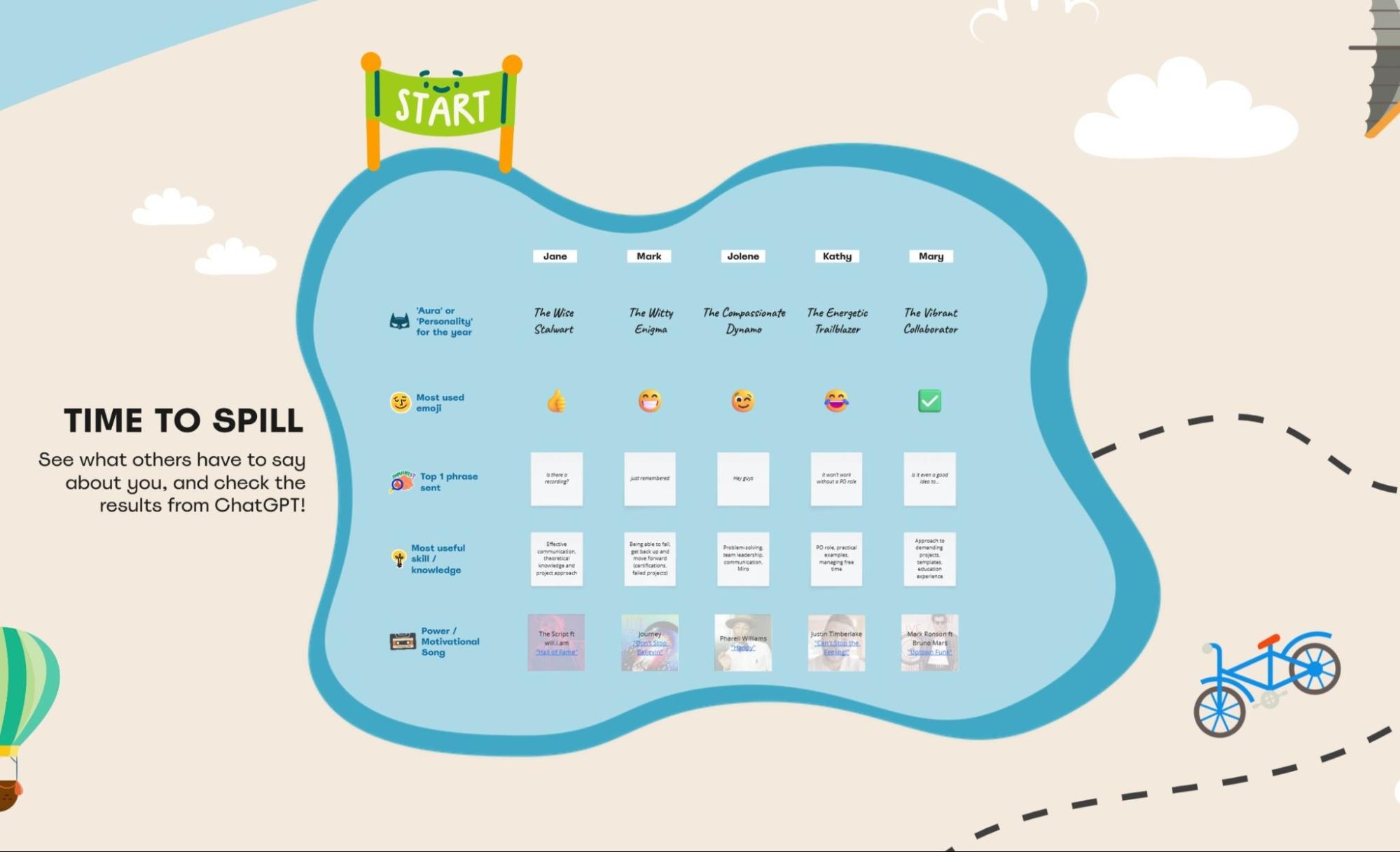
One of my first responsibilities as a Business Analyst team lead was to create an environment in which my team members felt connected, informed and motivated. Since we worked remotely across different parts of the country, our collaboration relied heavily on regular online team meetings. We used them to share updates from our projects, the company and the wider BA community, but also for knowledge sharing, lessons learned, retrospectives, etc.
To strengthen those connections further, we also organised team-building activities. The last one was held in a location geographically central to all team members, so everyone invested a similar amount of time and effort to attend. It turned out to be a great decision and helped us connect on a more personal level.
Another important part of this dimension was maintaining consistency and BA standards. At one point, we agreed to share our approaches to writing user stories and acceptance criteria, and to give each other feedback. This turned out to be a valuable and fun experiment! It was interesting to see how creative and different each of us was although we were working in similar roles.
However, not all challenges were structural. After six months in the company, one team member was let go. This had an immediate impact on team motivation and atmosphere. I stayed in contact with her and later shared the positive news with the team when she found a new job. It didn’t undo the situation, but it helped bring a sense of closure during a difficult time.
All of these experiences reminded me why team management matters and what my role as a Team Lead truly was. They confirmed that I wasn’t “the boss”, but an equal professional with a different responsibility: to encourage experience sharing, listen to suggestions and acknowledge milestones. Even as a distributed team, those moments reminded us that we were still working toward something together.
Second dimension: Individual leadership
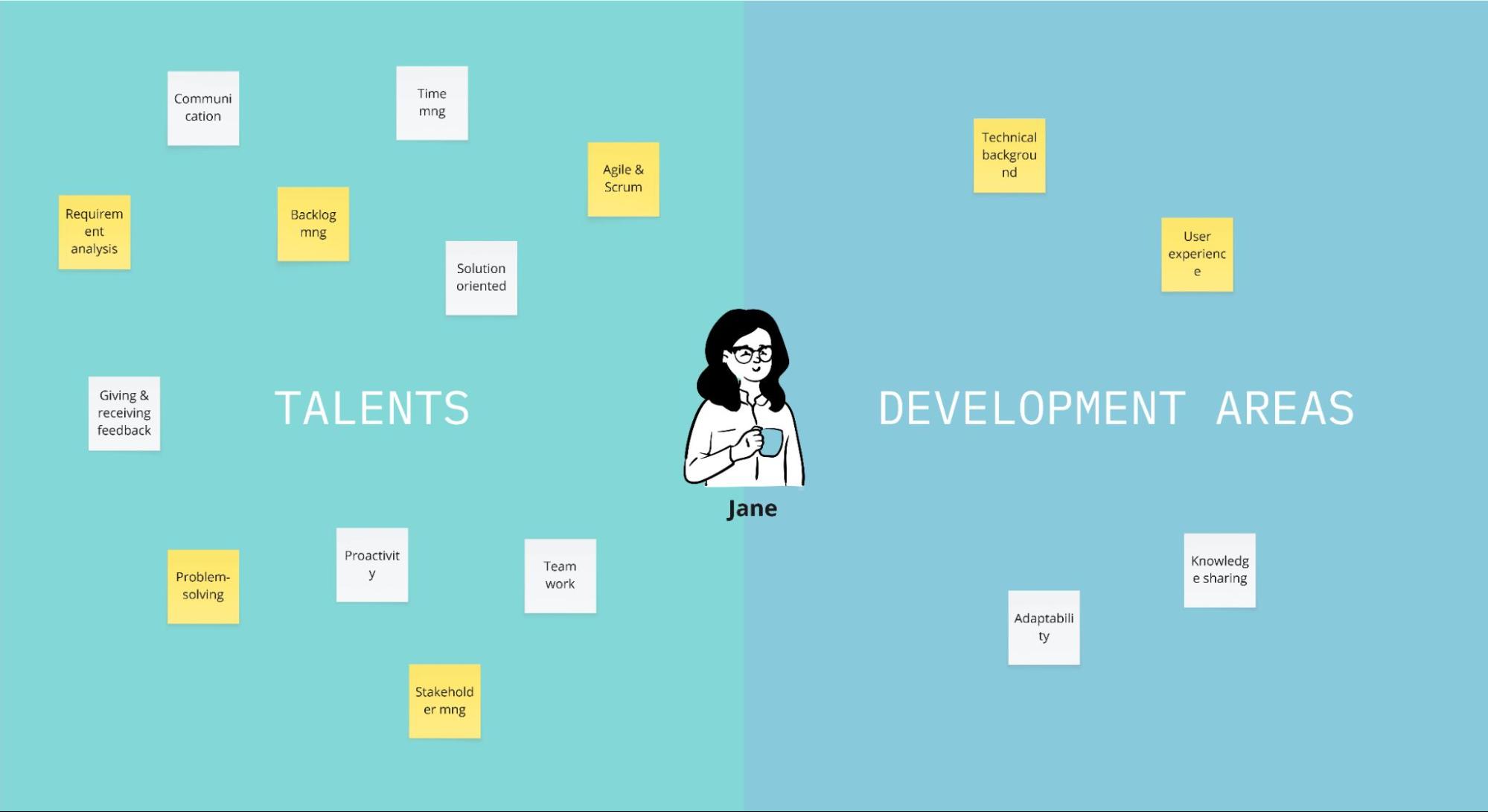
While team management focuses on the team as a whole, this dimension required me to coach, mentor and support each member individually. Regular one-on-one meetings were central, providing a safe space to discuss challenges, ambitions and concerns. During this time, I learned that a single leadership approach doesn’t work for everyone. Each person has different strengths, motivators and communication styles. Therefore, I needed to adapt my approach to support individual progress.
This was particularly challenging because I didn’t work directly with my team members. We were on different projects, so I had to invest a lot of time gathering information about their work, understanding their skills and areas for improvement, and ensuring they were able to apply their knowledge effectively in practice.
Another challenge for me was giving constructive feedback, especially when feedback from member’s project colleagues was negative and the person didn’t respond well initially. It took patience, repeated conversations and careful guidance. Over time, however, progress became visible which was incredibly rewarding to witness.
Now, you might be wondering if I really had to invest so much time and effort into this. Partly, I did because of yearly performance management. Team members validated their work and completed a self-assessment, after which I assessed their skills and knowledge based on the gathered information. Together, we discussed results, defined goals for the upcoming period and aligned on next steps.
But another part of me chose to work this way deliberately. I came to realise that individual leadership isn’t about checking boxes. It’s about being present, guiding thoughtfully and helping each person navigate their own path while contributing to the team and company goals.
Third dimension: My professional responsibilities
Alongside leading the team, I also took on responsibilities assigned by my manager. These included cooperating with other team leads, participating in job interviews, onboarding new team members, contributing to process standardisation, and supporting the promotion of the BA discipline both internally and externally. These activities required me to think beyond my own team and consider the broader context in which our work was taking place.
Furthermore, I continued to work half-time as a Business Analyst on an active project. Staying close to delivery kept me grounded in the day-to-day realities my team members were facing, and helped me to better understand the challenges of the role firsthand. One such experience, on a healthcare development project, later became an opportunity for deeper reflection on my BA role.
As you can imagine, my to-do list was pretty large at the time. I sometimes found myself questioning where I needed to invest my time and energy: the active project or my Business Analyst Team Lead responsibilities. This is where prioritization became essential. At the same time, I had to turn off my perfection mode and accept that having unfinished tasks did not mean I was failing. It was simply part of balancing multiple responsibilities.
What about me, myself and I?
This ongoing tension between delivery, leadership and expectations eventually led me to the fourth dimension: myself.
If you’re fortunate to have a manager who leads with the care and attention you need, this dimension may feel less heavy. I was lucky in that sense. At the time, I worked with a leader who cared about my mental and emotional state, encouraged me to be more conscious of my talents, needs and boundaries, and took my professional development seriously.
Still, I learned that self-management cannot be delegated. Leading others requires emotional energy, presence and clarity. Without regularly checking in with yourself, burnout becomes a matter of when, not if. I had to deliberately make time to reflect on what made me happy, what drained me, what I wanted to develop further, and what I actually needed.
Easy framework for difficult situations
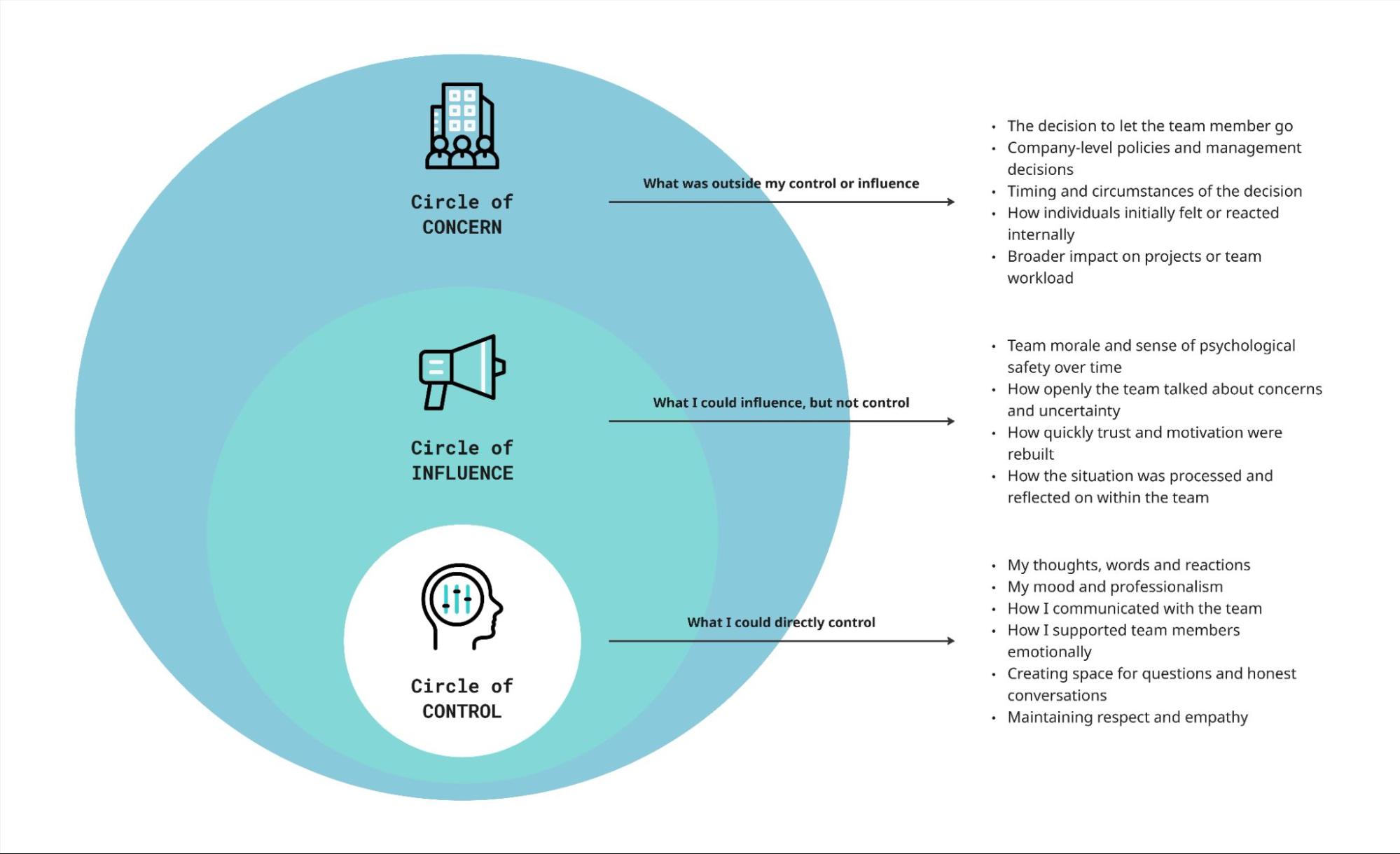
One tool that I found particularly useful came from a leadership session where we explored the Circle of Influence, a concept popularized by Stephen R. Covey. Whenever I felt overwhelmed, I returned to this model and asked myself a simple question: What can I actually do about this?
I started by separating things I could directly control from what I could only influence, and from what was outside my reach. That distinction helped me slow down, ground myself, and respond intentionally rather than reactively.
Let me explain this through an example illustrated in the visual below: when a team member was unexpectedly let go.
- The inner circle represents things that were fully mine to own: my reactions to the news, my communication to the team members, and the emotional tone I set for the team.
- The next circle captures areas I could influence over time, such as trust, psychological safety, and how openly the team processed uncertainty.
- The outer circle reflects everything I had to consciously let go of: decisions made by the company and other employees, timing, and individual emotional reactions I could neither predict nor control.
Seeing the situation mapped this way didn’t make it easier, but it made it clearer. And that clarity allowed me to focus my energy where it could actually make a difference.
From triangle to rectangle
Looking back, I am genuinely glad that I accepted the BA Team Lead role.
What started as a leadership triangle evolved into a rectangle, with self-management as the fourth and equally important side. Over that year and a half, I learned so much. I learned not only about leadership and the wonderful people I had the chance to work with, but also about my own skills, development areas, interests and needs.
Most importantly, this experience taught me a principle, often attributed to Denis Waitley, that changed me both professionally and personally: “Change the changeable, accept the unchangeable, and remove yourself from the unacceptable.” Understanding what you can control, what you can influence and when it’s time to step back is the lesson I value most from this journey, and one I hope to share with others.
Give Kudos by sharing the post!
ABOUT AUTHOR

Jelena Frlan
Business Analyst